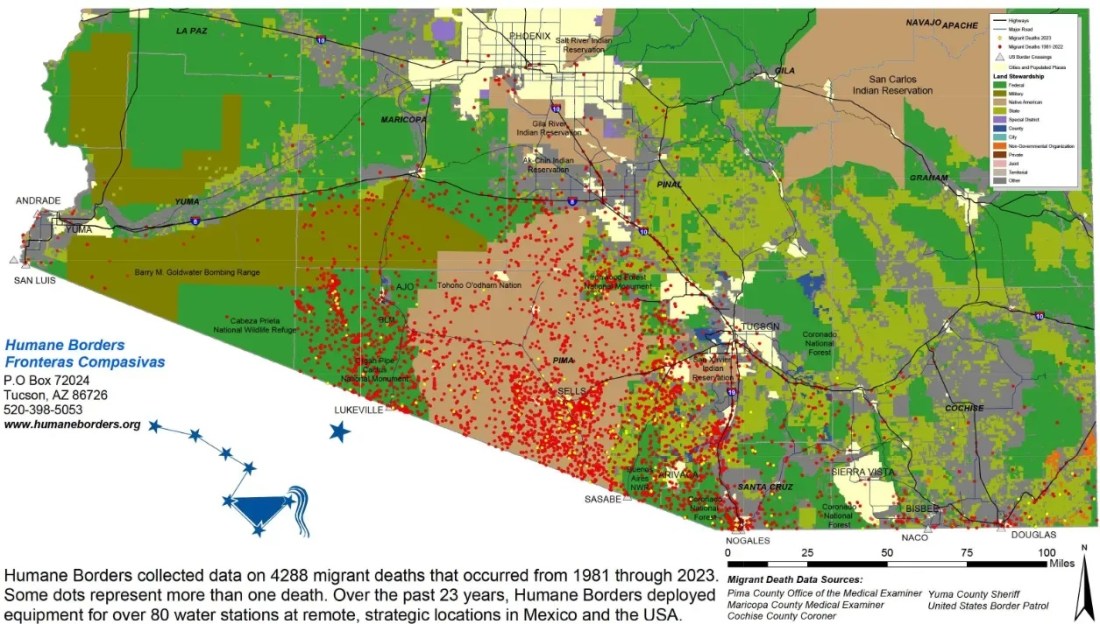
Every year as summer approaches, the monthly tally of migrant deaths at the US/Mexico border increases. While the number of undocumented border crossings has been down in recent months, one thing is for sure: as the summer heats up, more migrants will die.
In 2022, the last year for which numbers are available, Customs and Border Patrol (CBP) reported 895 migrant deaths. Previously, the worst year had recorded deaths in the mid-500s. Documented migrant deaths are likely the tip of the iceberg when it comes to those lost to family members during migration to the United States. CBP numbers only reflect the remains that are found, not migrants reported as missing.
Migrant deaths are one consequence of increased US border security policy. As the border gets harder to cross, people cross between ports of entry in more remote areas to avoid detection. They can spend days walking through desert terrain, exposed to brutal elements and often running out of water, while others drown crossing the Rio Grande.
The border is not the only area where migrants die while making their way to the United States. Many migrants report that crossing Mexico is the most dangerous part of their journey. This is not due to exposure to the elements but rather to exposure to criminal organizations, too often in collusion with police or other officials. Migrant kidnapping has become a common practice in Mexico. The families of kidnapped migrants are called and extorted. If the families can’t pay, migrants can end up dead or forced to work for the criminal group.
Another dangerous region is the Darien Gap, the stretch of isthmus connecting North and South America, between Colombia and Panama. There are no roads that connect these two countries. Until just a few years ago, this mountainous region, covered by dense jungle and fast-moving rivers, was considered impassable. Migrants crossing the Darien succumb to rivers, wild animals, snakes, falls, and criminal organizations. In 2022, the Missing Migrants Project of the International Organization for Migration (IOM) recorded 146 migrants missing in the Darien, likely a severe undercount given testimonials by migrants who survived the journey.
The Missing Migrant Project also documented 350 migrants missing in the Caribbean in 2022 and another 247 in 2023. Despite many migrants dying at sea, this region receives much less media attention.
The world is not organized in a way that makes it easy for the families of missing migrants to search for and identify their loved ones. Families will know where their person last made contact with them, but this is not necessarily where they went missing.
Even within the US it is not easy to report a missing migrant. Missing persons are supposed to be reported in the jurisdiction where they went missing. But, if the family is not in that jurisdiction or does not know the exact location where their loved one was lost, they may find authorities unwilling to take the report. Few police jurisdictions want to have extra unresolved missing persons cases on their books.
While coordination between state and federal authorities to identify unidentified remains has improved in recent years, it is still complicated. There is more than one government database with information that could be helpful. Furthermore, non-governmental organizations and the families of the missing person may be hesitant to report to government authorities or provide DNA for testing, especially if they are undocumented.
While identifying remains in the US is complex, the level of difficulty goes to a whole other level when more than one country is involved. Sharing identifying information across national boundaries requires legal agreements and cooperation by governments.
As the weather heats up, it is a good time to remember the risks that undocumented migrants take. For some, this will be their final journey and the beginning of a long search process for their families.
- First published by the Henry J. Leir Institute for Migration and Human Security Monitor, June 2024

 Joy Olson's blog